Saturday, November 24, 2018

Paul in Philippi II


Above are the ruins of ancient Philippi. Besides baptizing Lydia, Paul also cast out a demon of a slave girl, who had made her owners a lot of money because of her ability to predict the future, thanks to the demon. 


This loss of revenue angered the girl's owners and they had Paul brought to court, near the area above. Our guide Alexandra told us that when a trial was going on if it wasn't a good case, the crowd would rush the bench!


But in Paul's case, he and his companions were flogged and thrown into jail. And then this happened:

About midnight, while Paul and Silas were praying and singing hymns to God as the prisoners listened, there was suddenly such a severe earthquake that the foundations of the jail shook; all the doors flew open, and the chains of all were pulled loose. When the jailer woke up and saw the prison doors wide open, he drew his sword and was about to kill himself, thinking that the prisoners had escaped. But Paul shouted out in a loud voice, "Do no harm to yourself; we are all here." He asked for a light, and rushed in, trembling with fear, he fell down before Paul and Silas. Then he brought them out and said, "Sirs, what must I do to be saved?" And they said, "Believe in the Lord Jesus and you and your household will be saved." So they spoke the word of the Lord to him and to everyone in his house. He took them in at that hour of the night and bathed their wounds; then he and all his family were baptized at once. He brought them up into his house and provided a meal and with his household rejoiced at having come to faith in God.  
                                                                                                   Acts 16:25-34


We don't know exactly where all the above events transpired, but it wasn't far from this area.


Ruins of ancient churches and other buildings in Philippi.


The arches.


The different layers of the wall.


The crosses.


The flooring.


The auditorium.


The stairs. 


And this is my prayer: that your love may increase ever more and more in knowledge and every kind of perception to discern what is of value. so that you may be pure and blameless for the day of Christ, filled with the fruit of righteousness that comes through Jesus Christ for the glory and praise of God.
                                                                                                        Philippians 1: 9-11

Paul in Baptizes Lydia in Philippi


Beautiful lake on the way to Philippi

From Turkey, Paul went to Philippi, a Roman colony in the Macedonia region of Greece. As usual, he wanted to talk with people about Jesus Christ.


"On the sabbath we went outside the city gate along the river where we thought there would be a place of prayer. We sat and spoke with women who had gathered there. One of them, a woman named Lydia, a dealer in purple cloth from the city of Thyatira, a worshiper of God, listened, and the Lord opened her heart to pay attention to what Paul was saying. After she and her household had been baptized, she offered us an invitation, 'If you consider me a believer in the Lord, come and stay at my home,' and she prevailed on us."
                                                                                                                    Acts 16: 13-16

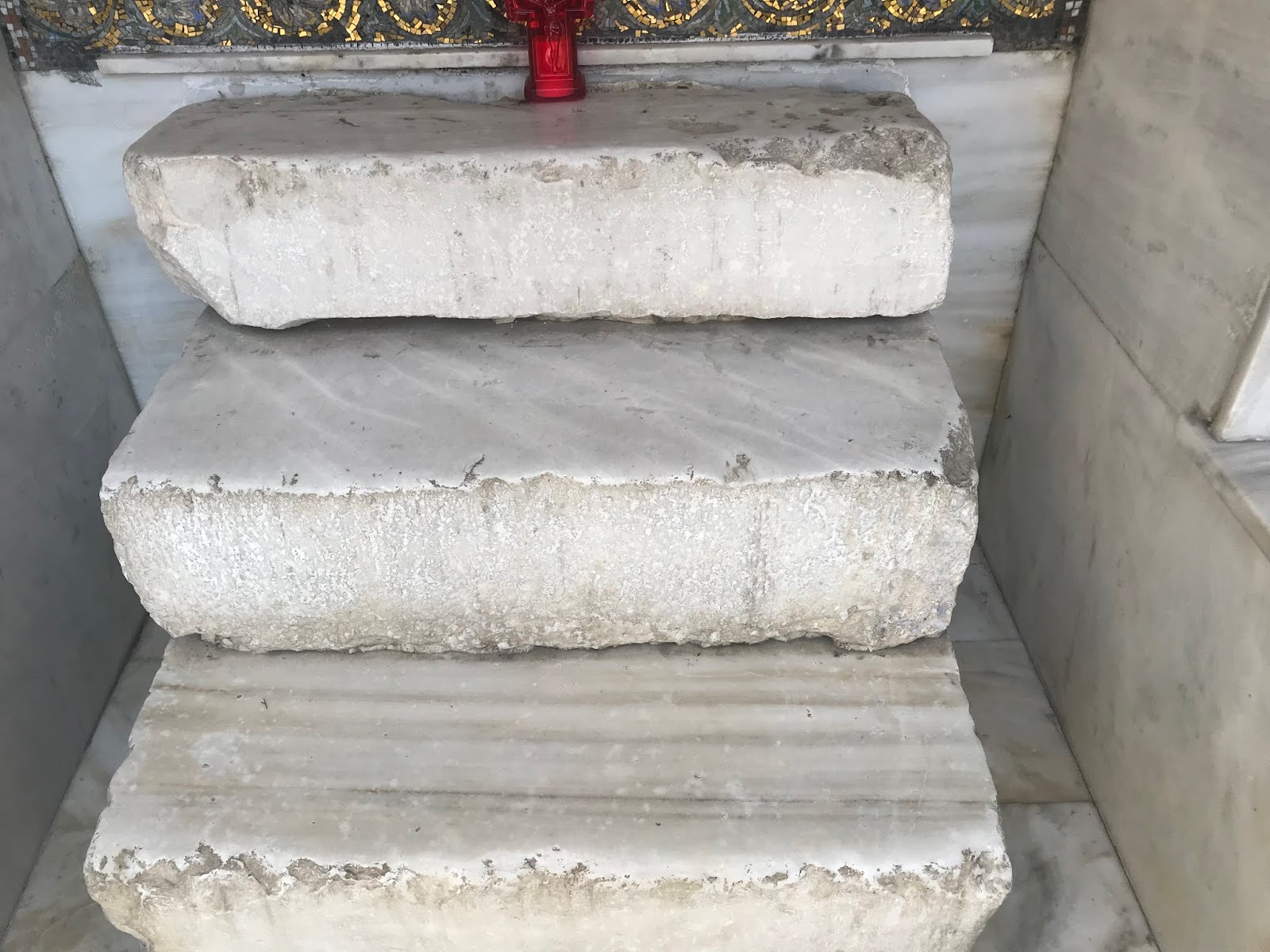
The slabs of stone in the photo above date to the time of Paul.


In way, it's amazing how quickly some of the people Paul spoke to, like Lydia, were converted. They had gone along their whole lives believing what their parents believed, and what likely generations before them had believed. Then they hear the Good News of Jesus Christ and they believe--God come down to earth in human form, walking among them, and proclaiming the most fantastic things: the last shall be first, love your enemies, you must die to yourself to live, through suffering and the cross comes joy, death is not final. Maybe it was a relief to believe this, as impossible as it seems. Maybe, as Jeremiah said, God has written his law on our hearts and we know. We know what is good, true, and right, and it isn't the worldly wisdom of me first. It must have been so liberating to have someone come along and tell us how it really is, that God walks among us and within us, and what we know in our hearts to be true is true even if the world doesn't always reflect it.


Above, Fathers Michael and Bob prepare for Mass at the river where Lydia was baptized. It was difficult to hear Fr. Bob's soft voice above the rushing water, but I did hear him say at the end of his homily that we can surrender to God, step by step. Step by step in Latin is gradatim and that was my grandma's high school class motto: Gradatim.


We prepare to renew our baptismal vows.


Here is the Bapistry of St. Lydia.


Do nothing out of selfishness or out of vanity; rather, humbly regard others as more important than yourselves, each looking out not for his own interests, but also to the interests of others.
                                                                                                                      Philippians 2:3-4


There were beautiful mosaics throughout the Bapistry of St. Lydia. Some of the Byzantine art is so severe; I like the lightness of the mosaic below of the child on the shoulders of the adult.


Church of the Immaculate Conception in Thessaloniki


In Thessaloniki, we went to Mass at the Church of the Immaculate Conception. Like many of the churches in Greece, its exterior is yellow.


This was a special place for me because my brother Jim was born on the Feast Day of the Immaculate Conception.


Love the crosses inside the hearts.


The Annunciation.


When I visit churches, I like to take a photo of the Ninth Station of the Cross, Jesus Falls for the Third Time. Jesus fell three times while carrying his cross. He gets up three times. This gives me hope for myself when I so frequently fall.


In the reflection after Communion, Father Michael asked God for the grace to carry out our vocations. This is exactly what I want to do, what I recommitted myself to doing after Jim's death. I lit a candle for Jim in the church.

Altar in Beria/Veria


We are back traveling in the Footsteps of St. Paul to Berea, in the Macedonian section of Greece.


Paul had come to Macedonia from Asia Minor (Turkey). In Turkey, he had a vision recorded in the Acts of the Apostles.

 During the night Paul had a vision. A Macedonian stood before him and implored him with these words: "Come over to Macedonia and help us." When he had seen the vision, we sought passage to Macedonia at once, concluding that God had called us to proclaim the good news to them. 
                                                                                                                                         Acts 16:9-10 

The above mosaic at the altar in Berea depicts the scene. Would that I respond to God's promptings in my own life with such alacrity.


Paul visited other Macedonia cities first, and arrived in Berea, when he was chased out of Thessalonica. Berea was an important cultural center of Macedonia, home to Greeks and Jews, intellectuals and artists. The people in the synagogue were more receptive to Paul's message as depicted in the mural above at the altar in Berea.

"These Jews were more fair-minded than those in Thessalonica, for they received the word with all willingness and examined the scriptures daily to determine whether these things were so. Many of them became believers, as did not a few of the influential Greek women and men."
                                                                                                                                       Acts 17:11-12


Above are the steps from where Paul preached.


Father Michael and Father Bob prepare for our prayer service.


Father Michael prays at the steps.


Paul proclaiming the Good News from the simple steps below.


Monasteries of Meteora


From Delphi we drove to an area of Greece called Meteora, where there are historic Greek Orthodox monasteries perched on spectacular natural pillars.


Before the monasteries existed, monks lived in caves on the sides of the pillars. 


At one time, 24 monasteries perched on these pillars. Six remain. We visited St. Stephen's, which now serves as a convent.


Women visiting St. Stephen's had to put skirts over their slacks to enter the monastery. We were not permitted to take photos inside the church.


The Catholic Church and the Greek Orthodox Church, which predominates in Greece, are very similar. Some of the differences have to do with beliefs about the Holy Spirit and the role of the Pope. In the Orthodox Church, they cross themselves with their left hand, first at their forehead, than at the center, next the right side and ending at the left side, "over the heart," as our guide Alexandra told us.


Here our Greek guide Alexandra on the right is with Leigh, who organized many of the details of our tour. Alexandra told us that many of the the novices were young women or older women who had experienced "a strong disappointment." After three years at the convent, if the the women have "a full heart" they make final vows.


A way of transporting goods to the monastery.


Below is the city of Kalambaka, where we stayed.


The morning after we visited St. Stephen's we returned to Meteora.


Here we scrambled up some rocks to get an even better view. I didn't get quite as close to the edge as Tom!


Onto to Berea.

Greatest Pics

View from the Acropolis in Athens I had a wonderful pilgrimage to Greece and Turkey, in the Footsteps of St. Paul. Here are some of the ...